Ask what happened before the verdict
A useful review describes the work behind its conclusion. Did someone read a public catalog, open a preview, sign in, test playback or watch the material being judged? Each action answers a different question. The word “review” alone does not tell you which took place.
Our own journal currently documents catalog metadata. It contains no hands-on story review. We make that scope visible so readers can use the comparisons without inheriting an experience nobody recorded.
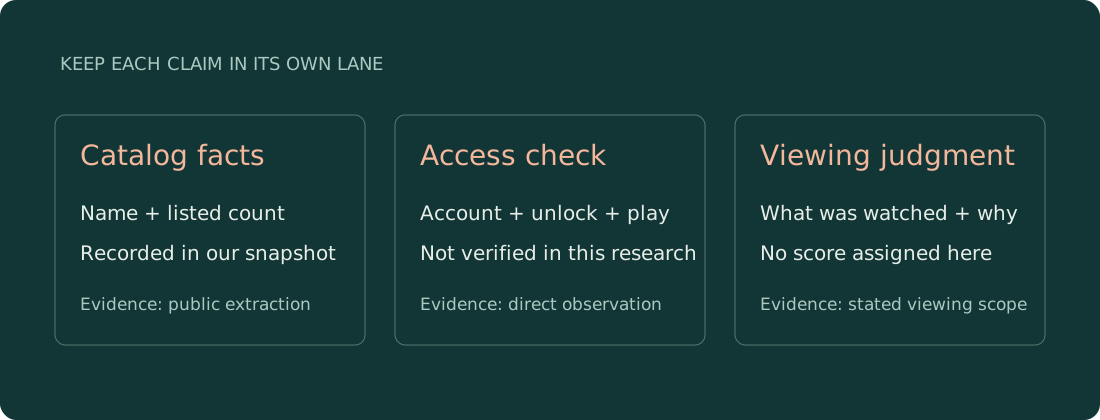
Four claims worth slowing down for
“There is plenty to watch”
Look for a definition. A count of listed episodes measures the number of entries. It does not establish their lengths, availability or completeness. A useful writer either supplies those missing fields or limits the sentence to the count.
“It is free”
Ask what “it” refers to: registration, a preview, a particular episode or the full service. An invitation to join is insufficient evidence for a promise about every item. Access observations should identify the account state and any visible boundary.
“It is the best choice”
Look for a stated criterion and a real comparison. “Fewest listed episodes in this six-record snapshot” can be checked. “Best story” would need viewing and an explained judgment. A winner chosen from missing fields is a preference presented as a finding.
“It works on mobile”
That could mean a page opened, a menu was usable or an episode played. The device, browser and completed action matter. A desktop image scaled to a narrow width does not prove a real mobile playback session.
Try a claim rewrite
Hypothetical overclaim: “Nine episodes make this the longest and most complete series.”
Evidence-sized version: “Nine episodes are listed. Runtime and completion status were not supplied in the observed catalog.”
The rewrite keeps the useful fact and removes two assumptions. It does not criticize the series. It explains what the number can support. This example illustrates a reasoning problem; it is not quoted from another publication.
Check the date and commercial context
A current-looking page can contain an old observation. Find the date of the actual test, not just the date in a footer. Then check whether the conditions you care about may have changed: the menu, access checkpoint, price or device support.
An affiliate relationship is relevant context, but it does not independently prove or disprove a claim. Look for a disclosure and then evaluate the evidence. Our method describes the limits we apply to our own commercial coverage.
Turn uncertainty into your next check
Instead of adopting a broad verdict, identify one claim that matters to you and the action that could verify it. Save that question in the decision desk. If it cannot be answered with the available information, leave it unresolved.
A good review can narrow your search. The final choice still depends on your own constraints and the platform’s current conditions.